

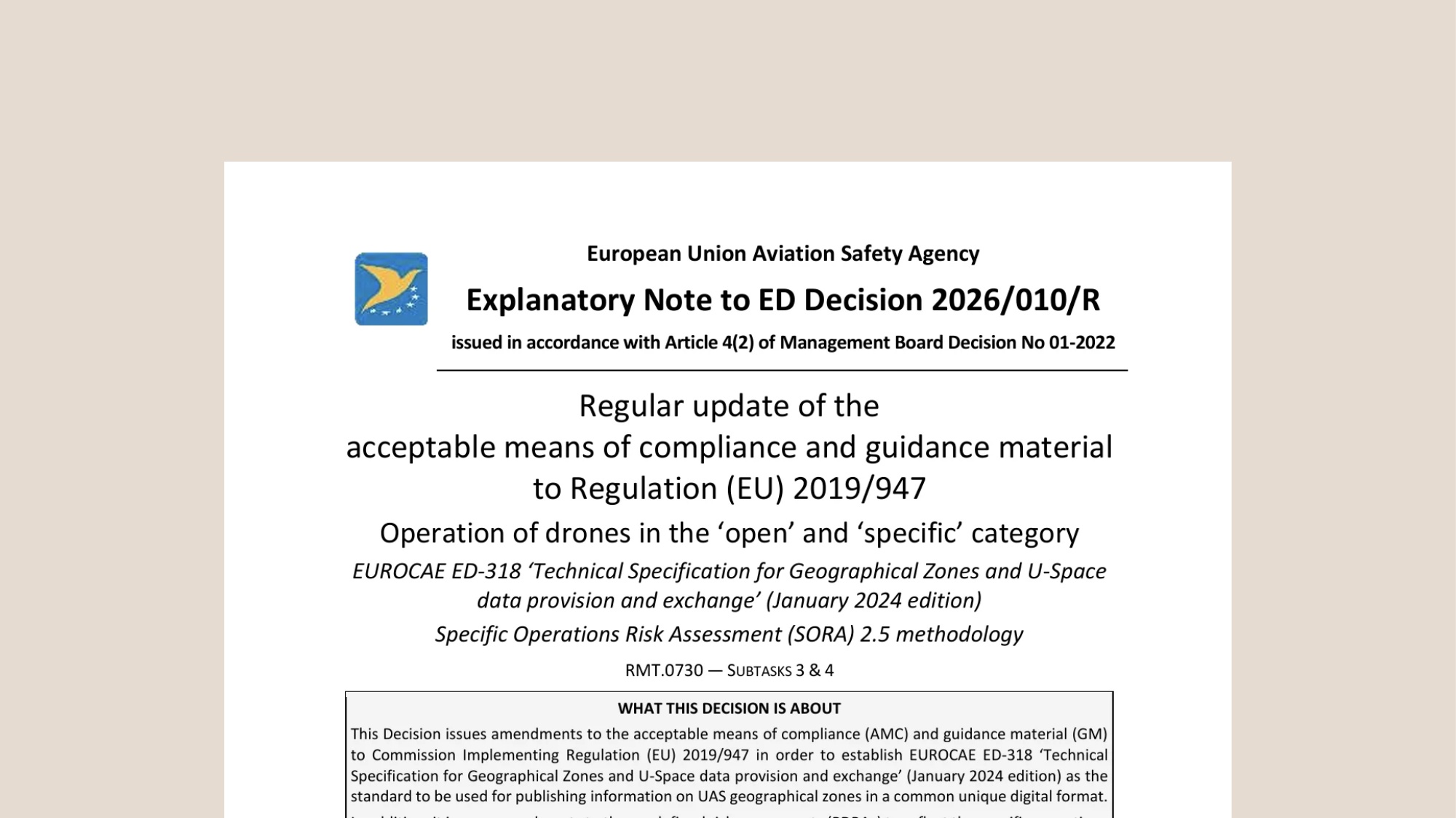
EASA published updated Predefined Risk Assessments (PDRAs) based on SORA 2.5 on 20 November 2026. The changes allow for heavier drones, higher flight speeds and revised population density limits. At the same time, the number of PDRAs has been reduced from five to three.
A PDRA is a predefined risk assessment that allows UAS operators to apply for an operational authorisation in the specific category without conducting a full SORA assessment. Operators must demonstrate compliance with the requirements of the applicable PDRA.
Allows heavier drones
One of the most significant changes is that the updated PDRAs no longer specify an upper maximum take-off mass (MTOM) limit. This allows significantly heavier drones to be used, provided that all other requirements are met.
All three PDRAs cover drones with a maximum characteristic dimension of 3 metres and a maximum speed of 35 m/s.
Revised population density limits
The updated PDRA-G01 and PDRA-G02 introduce revised population density limits for the operational volume and ground risk buffer:
Drones with an MTOM of up to 25 kg: Less than 50 people/km², provided that the vast majority of people in the area are sheltered by buildings or other structures.
Drones with an MTOM above 25 kg, or where people are not sufficiently sheltered: Less than 5 people/km².
All three PDRAs also specify maximum average population density limits for adjacent areas, expressed in people/km².
From five PDRAs to three
EASA has reduced the number of published PDRAs from five to three. PDRA-S02 and PDRA-G03 have been removed, as the operations they previously covered are now included in the updated PDRA-G02.
The three PDRAs are:
PDRA-S01: Visual line of sight (VLOS) operations over a controlled ground area. Based on STS-01, but without the requirement to use a C5-class drone.
PDRA-G01: Beyond visual line of sight (BVLOS) operations in uncontrolled airspace. The drone must remain within the detection line of sight of the remote pilot or an airspace observer, allowing other air traffic to be detected during the operation.
PDRA-G02: BVLOS operations in reserved or segregated airspace, or close to obstacles in an atypical air environment.
The updated PDRAs also introduce revised requirements for ground risk assessment, operational limitations and documentation in line with SORA 2.5.
New competency requirements for PDRA-G01 and PDRA-G02
The updated PDRAs specify the following competency requirements for remote pilots:
PDRA-S01: As before, remote pilots must hold an STS theoretical knowledge certificate and STS-01 practical skills accreditation.
PDRA-G01 and PDRA-G02: Remote pilots must hold an STS theoretical knowledge certificate and STS-02 practical skills accreditation.
The STS competency requirements are new for PDRA-G01 and PDRA-G02, where pilot competency requirements were previously largely addressed through the operator's own training programme.
When do the new PDRAs apply?
The updated PDRAs entered into force on 21 November 2026 and can be used as the basis for new operational authorisation applications.
From 1 January 2027, SORA 2.0 and the previous PDRAs will be phased out. National aviation authorities may, however, continue to accept applications based on the previous PDRAs during a transitional period.
Existing operational authorisations do not automatically expire as a result of these changes.
What do the changes mean for UAS operators?
The updated PDRAs provide greater flexibility, particularly for operators using heavier drones or conducting BVLOS operations. More operations may now fall within the scope of a predefined risk assessment, removing the need for a full SORA assessment in certain cases.
An operational authorisation from the Norwegian Civil Aviation Authority is still required for operations in Norway, along with documentation demonstrating compliance with the applicable PDRA.
Sources: